The Ultimate CDL Training Guide: A Step-By-Step Roadmap
Getting a Commercial Driver’s License (CDL) is a little more involved than going to the nearest Department of Motor Vehicles and taking a driving test. But with a little guidance, some study, and plenty of practice, a career in truck driving can become a rewarding lifelong career. Even people who have started careers in a completely different industry can start a truck driving career in a matter of months.
But knowing how to get a CDL is the first step in starting down this path.
CDL Training: Getting Started
A CDL requires specific steps and requirements that you must follow. The process of obtaining a CDL is like getting a regular driver’s license. But being a professional truck driver carries additional duties and responsibilities that requires more training.
Eligibility & Entry Requirements
To be eligible for a CDL, you must:
- Be at least 18 years old to drive within the state you got your license. For interstate driving, you must be 21 or older.
- Have a valid regular driver’s license and a clean driving record
- Pass a Department of Transportation (DOT) physical examination
- Pass a drug screening
- Have documentation that proves your identity, U.S. citizenship or legal residency, and a valid Social Security number will be needed
The three types of CDLs
There are three types of CDLs: Class A, Class B, and Class C. Each has specific differences, benefits, and challenges.
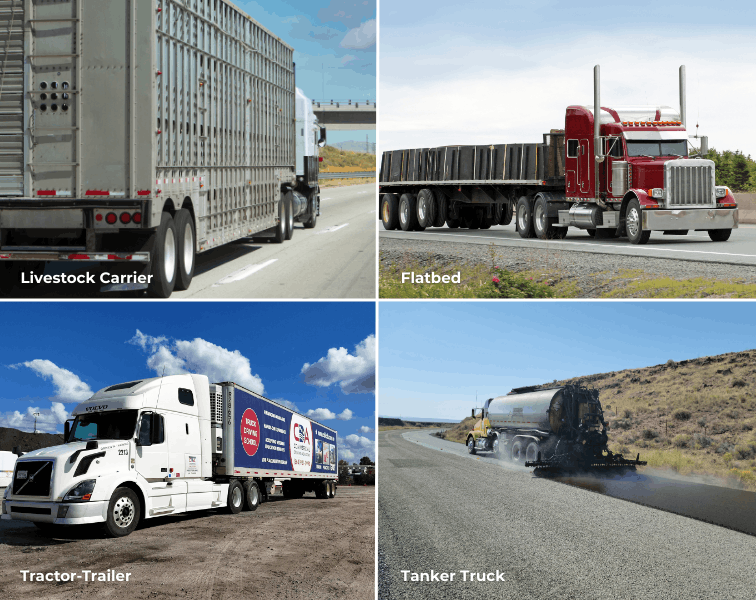
Class A: The most versatile license type, it allows drivers to operate vehicles with a gross combination weight rating (GCWR) over 26,000 lbs. where the trailer weighs over 10,000 lbs. Someone who holds a Class A CDL can drive vehicles like tractor trailers, tanker trucks, livestock carriers, and flatbeds.
Class B CDL: Drivers may operate single vehicles with a GVWR over 26,000 lbs pulling a trailer under 10,000 lbs. Class B CDL holders can drive box trucks, large buses and dump trucks.
Class C CDL: For single vehicles under 26,000 lbs. that carry hazardous materials or hold 16 or more passengers (including the driver). A Class C CDL holder usually drives vehicles like passenger vans, small Hazmat vehicles, and some school buses.
Endorsements & Certifications
Adding endorsements to your CDL can boost a truck driving career. Endorsements are special certifications that allow truck drivers to operate special vehicles or haul certain cargo, which require additional training and testing. Some of these allow truck drivers to add earning potential or gives them additional work options.
- Hazmat (H): Allows drivers to haul materials like gas, oil, or chemicals. The Hazmat certification requires a TSA background check and fingerprinting
- Passenger (P): For vehicles designed to carry 16 or more passengers (including the driver)
Selecting a CDL training program
In order to be considered a reputable CDL training school, it should be Early Learner Driver Training (ELDT) compliant and Federal Motor Carrier Safety Administration (FMCSA) registered. ELDT is the FMCSA’s regulations establishing the minimum training requirements for entry-level drivers.
For most people starting a CDL program, cost is certainly a factor, but it shouldn’t be the only one. A good CDL school should provide:
- Complete behind-the-wheel training
- Low student-to-instructor ratios
- Experienced instructors with commercial driving backgrounds
- Late-model trucks similar to what you’ll drive on the job for driving practice
Commercial Learner’s Permit
Before beginning truck driving training, you must get a Commercial Learner’s Permit (CLP). The CLP allows you to drive on public roads, but only accompanied by a driving instructor, much like a regular learner’s permit.
To get a CLP, you must:
- Meet the requirements for a CDL (be 18, pass the DOT physical, proof of identity, clean driving record)
- Pass state-specific knowledge tests
You must hold a CLP for at least 14 days before you can take the CDL skills test.
CDL Curriculum Overview: Classroom and On-Road Coursework
The CDL training curriculum is generally made up of two parts: classroom work and behind-the-wheel training.
Classroom Coursework
Classroom work is the foundation of a CDL education. Drivers are taught regulations and vehicle operation and safety procedures. The curriculum covers simple operations, safety protocols, advanced driving practices, vehicle systems, and non-driving activities.
To pass, you must show proficiency in all areas by scoring at least 80% on assessments. Some programs give you this training through online platforms or in-person sessions, allowing you to study at your own pace.
Behind-the-Wheel Practical Training
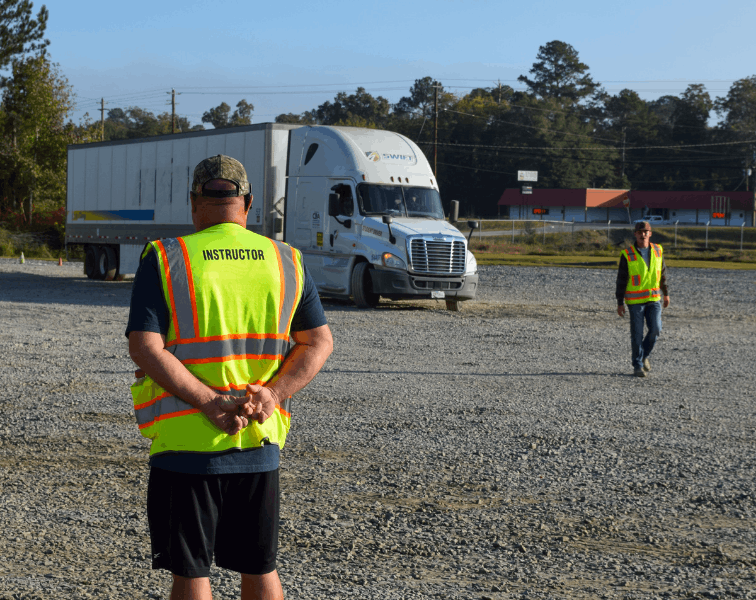
Practical training starts after classroom instruction ends. Drivers practice operating trucks in controlled range environments and on public roads. Range training lets drivers practice simple maneuvers like straight-line backing, alley docking, and parallel parking.
Public road training builds on these fundamentals and teaches drivers to guide through different traffic situations. Instructors document your progress and verify skills throughout both parts of training.
Preparing for the CDL Exam
The CDL exam is broken into two parts: the written test, and the skills test.
Written Knowledge Test
The written exam tests your grasp of commercial driving basics through multiple-choice questions. Most states need you to pass three separate tests: General Knowledge (50 questions), Air Brakes (25 questions), and Combination Vehicles (20 questions). Your state’s CDL manual should have everything you need. Make it your study guide.
To improve your chances of success:
- Take practice tests often to spot knowledge gaps
- Create flashcards for tough concepts
- Study where you won’t be disturbed
- Rest well before exam day
Skills (Road) Test
After holding your CLP for at least 14 days, you can take the three-part skills test. You complete this test in a truck, driving on the road. This hands-on evaluation includes:
- Pre-trip inspection – Complete the pre-trip inspection, checking vehicle parts properly and explaining what they do
- Basic vehicle control – Complete maneuvers like straight-line and offset backing and alley docking
- Road test – Handle real traffic while using proper signals, mirror checks, and space management
Career Outlook and Advancement
The truck driving industry has a huge driver shortage right now, which means great job security for anyone who gets their CDL. A report from the American Trucking Association showed 60,800 drivers were missing in 2018, and this number could reach 160,000 by 2028. This shortage means drivers can get better pay and more job choices.
Job Demand & Growth Prospects
The US Bureau of Labor Statistics shows trucking jobs are growing faster than ever. By 2029, there will be 160,600 new positions available. CDL holders can count on stable work, especially with online shopping pushing up shipping needs.
Work-Life Balance & Route Options
The type of route you choose shapes your lifestyle:
- Over-the-road (OTR): Best pay but longest time away from home
- Regional: Good balance with weekly home time
- Local: Home every day
Conclusion
A career driving a truck is an appealing career option for a lot of people. It has steady work, options for different job types, and strong ongoing demand that means a safe, responsible driver can enjoy a long, distinguished career.
A CDL is within your reach. Get more information on how you can enroll in CDL training at Commercial Driving Academy and start your career today.
FAQs
How long does CDL training take?
It depends on that type and how you train. At full-time Class A program lasts 3 to 7 weeks. A part-time program can last up to six months. A Class B CDL program can be completed in as few as 2 to 4 weeks.
Do CDL schools offer financial aid?
Yes. There are many options for financial aid for CDL training:
- Military benefits – Your GI Bill benefits apply to this training
- Scholarships – Look for specific programs like those from Women in Trucking
- Grants – Money given by a government, foundation, or corporation designed to fund your education, including Pell grants or the Workforce Innovation and Opportunity Act (WIOA)
What about free CDL training?
Some companies do offer “free” CDL training. This is called company-sponsored CDL training. Employers cover the cost of the driver’s CDL training in exchange for locking them into a job for a set amount of time.
But if the driver leaves the company before that commitment is reached, they are usually required to pay those training costs, which effectively trap the driver into employment. Since they’re forced to stay in the job, these drivers often find themselves driving the least-desirable routes and jobs.